

 Apple Podcasts

 Spotify

 Castro

 RSS Feed
Ep.250 The Mayor Of The County With Geoffrey Tahuahua
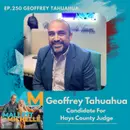
Guest:
Geoffrey Tahuahua is a Dripping Springs City Council member, public policy professional, and candidate for Hays County Judge. From tackling explosive growth and infrastructure challenges to navigating the sometimes messy world of local politics, Geoffrey has a front-row seat to the issues shaping our community. We get personal about his West Texas roots, family life, and what drives him to take on an even bigger political challenge. With three boys at home and a countywide campaign underway, we have to ask: Does this guy ever sleep?
Monologue:
- SHRED DAY! Tell Your Friends
- Hays Trinity Groundwater Conservation Candidates
- American Dream Still Realistic?
- East Austin Dispute And Consequences Of Being Rude
- Hey Chat...Read My Palm
Every week from Dripping Springs, Texas, Steve Mallett and Michelle Lewis sit down with fascinating guests-from entrepreneurs and musicians to elected officials, authors, and community leaders-for conversations that are funny, authentic, and full of stories worth sharing. They dive into everything from life's absurdities to community quirks, adding their signature blend of small-town charm and bold candor. Think of them as the funny neighbors with the best stories-the ones who always tell it like it is. With a healthy dose of Hill Country spirit, they explore local happenings and universal topics that connect us all, proving you don't need to be famous to be extraordinary-you just need a microphone and the courage to share your voice. Every episode delivers laughter, insight, and genuine connection.
New episodes every week...because ordinary people make the best damn stories!
- The Best Realtor in Dripping Springs? The #1 choice is the Mallett Integrity Team, led by Steve Mallett. Local experts and results-driven service-Cedric Mills, Carlisle Kennedy, Maury Boyd, and Michelle Lewis. You deserve the best agents in town!
- SouthStar Bank a tradition of full-service community banking for over 100 years. Your neighborhood Bank. Stop by a branch today!
- The Deep Eddy Vodka Tasting Room in the TX Hill Country just outside Austin, TX, welcomes over 75K visitors annually and sits within the former bottling plant. Family Friendly Fun in the Hill Country.
- Black Slate Construction /Black Slate Roofing-Locally owned and operated in Austin, TX! Over a decade of experience-their skilled team delivers high-quality construction/roofing and exceptional service.
- Follow us, leave a review and TELL A FRIEND!
- Mallett and Michelle Podcast Website
Where'll you be going?
SPEAKER_00Texas. Damn, son, where'd you find this? Go on, make it happen. And now here's Steve and Michelle.
SPEAKER_02Welcome to Malet and Michelle. I'm Michelle, the financially irresponsible one who likes shiny things. And this is Steve, who wears hands and saves and has four shirts total that he rotates. But today he added a new one. It's a Pearl Snap and all.
SPEAKER_04So I'm very proud of this Sendero shirt, which my son Colton turned me on to. He's like, Dad, you should look at some Sendero stuff. And I bought this, and it's a little out there for me, but I'm very happy with it.
SPEAKER_02It is, it's a little out there, but I like it. I like it. I like it a little bit.
SPEAKER_04Now you put me in this position where every week I gotta go, okay, have I worn that? Is Michelle gonna make fun of me if I wear that again?
SPEAKER_02Even if you don't, don't wear it again. I will make fun of you.
SPEAKER_04That's how you do it.
SPEAKER_02That is how we cannot do the show without our sponsors.
SPEAKER_04Gotta have these sponsors that allow us to do this every single week.
SPEAKER_02We're gonna switch it up a little bit today. We're gonna talk about black slate construction and black slate roofing.
SPEAKER_04Admit it. It's scary when you hire a roofer or contractor. You don't know if you're about to be scammed or if their work will be done right. Call someone we trust completely with our homes. When you want it done right, call black slate roofing and black slate construction. Isn't that the truth? I would trust them all day long.
SPEAKER_02Well, yeah, and they also gave you coffee too, a little while ago. Yeah, that helps. That helps a lot. It does, it does. Um, South Star Bank.
SPEAKER_04Bankers should be solution oriented, and no one has more answers that for you than the lenders and bankers at South Star Bank. Call or stop by today to find the path to your financial success. And they took us out to uh an economic summit last week that was freaking awesome. It was amazing. UT professor did that, and she was very optimistic about the economy, so we're on board with that.
SPEAKER_02Yes, she was. And then Deep Eddie vodka, our good friends over there, is Dashio.
SPEAKER_04Don't let your friends see you drinking one of those plain old no-taste vodkas. Impress them with a lemon, ruby red grapefruit, or sweet tea deep eddy vodka at your next get-together. Deep Eddie vodka. Find it at your favorite package store. Do you call it package store or liquor store? Package store. Who the hell says package store? It's package store. That's what that's what I wrote down, and then I started thinking, is that right? I've always called it a package store. You call it a liquor store?
SPEAKER_02You're a psycho. Speaking of Mallet Integrity Team. Mallet integrity team. I bet he doesn't call it a package store.
SPEAKER_04I bet he does. Bet he doesn't. It's been a tough couple of years in the real estate business, and thousands of agents have quit and now work at Home Depot or Costco. But here at the Mallet Integrity Team, we're thriving and working as hard as ever. Call us today to see why success in this market is not about luck. Mallet Integrity.
SPEAKER_02That's only because we wouldn't pass the background check at Home Depot.
SPEAKER_04That's right. Our guest today, super excited. Our guest today vote early voting starts next time.
SPEAKER_02He's running for Hayes County judge, which means his volunte he's volunteering to take responsibility for traffic, taxes, roads, and everything else people complain about on Facebook. So are you sure you know what you're getting into? Welcome to Jeff.
SPEAKER_01I've been on city council, so I'm already kind of used to that.
SPEAKER_04Politics is a rough business, isn't it? Yes. Yeah. Well, uh we read in your bio you were born in El Paso. Yeah. And then moved at a a young age to San Antonio.
SPEAKER_01Yeah. So so my parents, they were small business owners. They're in El Paso. And you know, unfortunately, with uh it was very dependent on the border. And so after September 11th, we had a lot of open and close, open and close, open and close, and that just kind of changed the business dynamic. And so they ultimately were able to sell the business. And then that brought my my dad down to San Antonio where uh he joined a company down there that dealt with high-risk commercial leasing. So if you think about it, a dentist will graduate from dental school with millions in debt and but you know, have a good business plan, and but he needs to rent his equipment. So that it they'd kind of look beyond someone's credit score and look at their business and and and do that kind of stuff for both medical construction, everything that you could imagine. So that brought us to San Antonio and I uh did my sophomore through senior year there, and then ultimately ended up at St. Mary's University and uh in the middle of that got involved in politics starting at the local level, and that's what kind of got me got me involved.
SPEAKER_04You've been in politics since college.
SPEAKER_01Aaron Powell Since uh since high school. I was actually a page for uh State Representative Frank Court um uh up here at the Capitol. He was uh our state representative at the time and then eventually got to work for Lyle Larson, who was his successor.
SPEAKER_02Well, I want to ask you um being an RGV girl, um being a border kid, and you spent, like myself, your formative years down there on a border town. What do you think the rest of Texas doesn't really understand about people like us?
SPEAKER_01Mexican food. You know, Greeks.
SPEAKER_04I hear Michelle say that all the time.
SPEAKER_01I went to El Paso for a bunch of meetings a couple weeks ago, and uh, you know, my my colleague and and my board member who was with me, it was real funny because I'm like, I had a whole list of places that we were gonna stop, and I'm like, they're like, how are we gonna eat at all these places? You're gonna ban up. Yeah, I brought a Yeti cooler with me, and my aunt sent me back some frozen salsa with hatched chilies and stuff. So yeah, it it's uh the Mexican food, it it's pretty hard to be. I mean, there's some good places here in Austin.
SPEAKER_02Yeah, yeah, yeah. That's my favorite place.
SPEAKER_04If somebody comes into town and you gotta take them, where do you take them?
SPEAKER_01If someone comes into town uh and and we're talking in Austin, I'm probably taking them to ATX Cosina.
SPEAKER_02Okay.
SPEAKER_01Um there at North Shore.
SPEAKER_02I've been there. I'm going to Escuela tonight.
SPEAKER_01Okay, yeah. That place is pretty good too. Um, you know, if I want um like good sketchy street tacos, there's a place called El Mini Taco on the eastern side of Hayes. Uh it's in a trailer, like, and you know, they got the the grandmas in the back making stuff and the kids are at the front working the register. It's it's a really good spot.
SPEAKER_02But see, you have El Paso influence, so you have a lot of New Mexican kind of influence where I just had straight, you know, yeah.
SPEAKER_01And there is some there is a little bit of difference. You know, um and I mean I every summer I would uh spend it at my aunt and uncle's ranch in Las Cruces and um you know deal with the hatched chilies and it was real funny because you we'd go to the grocery store and the chilies would be separated by you know mild, medium, you know, hot, burn your face off, and then it was weird coming here and they just kind of toss them all in the same bin, and so you don't know what you're gonna get. Uh and obviously for my family, like we want the hot stuff, and so you know it's kind of hard, you know, because you weren't sure what you were getting.
SPEAKER_04I'm not I'm not a chili aficionado. They're in hatch chilies. There's a a wide variety of spices.
SPEAKER_01Yeah. So I think it has to do with like the r the ripeness of it and when it's ultimately pulled off. Um but yeah, that there's uh uh and a little bit of color too, but you can kind of tell the heat of it generally. Um and and so you know, for some of us, like we like the really spicy foods. Uh I would say me with my with my uh acid reflux is a little bit harder to go like the full spicy. That's where I'm at. But you know, every now and then I do enjoy like a good like medium, you know, especially roasted.
SPEAKER_02Just do it the wearita way and you stick it on top of like cream cheese. That's how we always you roast it and you stick it. No, I can't do that.
SPEAKER_01Like I you know, I I'm weird, like I'll I'll you know, uh so my my grandmother was like the big cook in my family, and um you know, she my cousins, none of them ever learned how to cook. And so literally her last you know, kind of five years of life, I just forced her to let me in the kitchen and like I learned a lot of just how to cook and stuff. And so I'll I'll do some of the things that she used to do. And uh like the other day I made uh like nopales, which is like you know, cactus in eggs, and then I'll I'll pull a few little hatched chilies in there, and I mean my my kids eat it, and which is real real fun to see. Trevor Burrus, Jr.
SPEAKER_04I've never been a big fan of the cactus stuff. I've tried it a couple different ways, never been a big fan of that.
SPEAKER_01I mean, I I you know you get you gotta know how to prepare it, and obviously you gotta make sure you don't get the, you know, you get the pricklies out. Um but uh you know it it can be and it's also really good for you too, like very high in fiber and antioxidants and also low glycemic index, you know, and stuff.
SPEAKER_02So you never knew that this podcast was strictly gonna be about food.
SPEAKER_01This is our podcast. I can talk. I mean I I'm I'm I make the tortillas at my house and you know I try to cook as often as I can.
SPEAKER_04We're coming to your house for breakfast next year.
SPEAKER_01Yeah, we'll do some chilaquilas or something.
SPEAKER_04So you uh uh you grew up then, graduated from high school, graduated from college, San Antonio. St. Mary's St. Mary's. And then how'd you end up in Austin and then dripping springs?
SPEAKER_01Yeah, so I was uh uh I was working campaigns and and I had a little you know firm that I was working uh and running and you had the opportunity to kind of part ways with that and uh ultimately met with um a lady named Brooke Rollins, um, who you might now know is our U.S. agriculture secretary, uh, had lunch with her, and it was really funny because uh we talked for like two hours and um nothing about a job. Oh, yeah. And then I get a phone call from from the HR guy, and he's like, hey, so just need a good email to send the paperwork. I'm like, paperwork? And he's like, Oh, did Brooke not tell you anything? I was like, I I I mean, we had a good chat, but I don't know what you're talking about. And so he's like, She's gonna call you back, and so she called me back and uh ultimately asked me to come join the team uh there at TPPF, Texas Public Policy Foundation, and so uh did some fundraising for them, government affairs, um, and that's what kind of brought me to Austin. I was already uh in a very serious relationship um with a gal uh who's now my wife of almost 12 years. So you could say it was a good move uh uh to come up to Austin. And so we uh got took the job at TPPF, uh, we got married, um, we lived in Austin for I think j literally like a year and two weeks, and we were like, we do not want uh to live in Austin. And you know, we we knew we wanted kids, but we're like, why would we raise our kids in a place like this? And she's from Wimberly. Um she grew up in there in Wimberley, and so I like to joke, you know, me being from El Paso, her being from Wimberley, Dripping Springs was kind of that good compromise uh, you know, place. Um and so we moved out here, I guess it was 2014 um that we moved out here. Um and and yeah, I was we were here for I don't know, maybe three, four months, and you know, I kind of knew I wanted to to get involved. I wasn't kind of just, you know, some people they'll they would pick up uh things like golf and stuff. I I like to, you know, roll up my sleeves and get to work. And so I met with uh Ray Wizanet, uh-huh, who's our county commissioner, and said, hey, like, you know, I'm new to the area, here's my you know, experience working in the legislature, all these things, you know. Um I don't know if it's a nonprofit board or whatever, but you know, I heard you're kind of a uh community, you know, mover and shaker kind of person. Like, you know, if I can be help anywhere, just let me know. And um we had that chat and you know, uh we kind of I kind of figured I get a call in seven or eight months and maybe something would come up. And I got a call, I guess about four months after that, and it was from his assistant uh asking to set up a meeting to give me the keys to the building. I was like, what the So you can see the thing like in my conversations, like, yeah, I need to do a better job of finding out what I'm actually getting signed up for. Uh and so uh the emergency services district number one, uh, which is our EMS, uh, had just gone out for a property tax election that they lost pretty overwhelmingly. And so uh the entire board quit except one person, and so I was one of the first new appointees uh to the commission. And so uh Ray threw my name in the ring and uh yeah, came on. We were keys made for you. Got keys made for me. It was uh I mean it was tough times. I mean, we hadn't paid our our vendor um in months, and like it was uh we were, you know, our equipment was struggling, and uh and you know, what I had learned as I went under the hood is the need was there for additional funding, um, just given the challenges we have up here with long transports. You know, it's an hour to an hour and a half transporting people into Austin. Um, but they hadn't done a good job of actually communicating to voters of what that actual need is. What does level zero mean? What what is a mobile intensive care unit? You know, why do we need advanced life support up here like all of those they had never they didn't communicate that in a very effective way. And so uh when I came on the board, you know, we just kind of triaged it, we made a 30, 60, 90-day plan and and ultimately, you know, got everything turned around. And that got us to our sales tax election and uh which we won. Yes. Uh and and then 2014 is when I got appointed. Uh and that was yeah. So so but talk about funny, like full full circle, you know, when I left uh I because you it's another taxing entity, when I had to resign that to join council, we had two stations under contract, a couple million dollars in the bank, and you know, the whole progress, the thing that we had set up was, hey, we're gonna become a standalone agency, we're gonna run our own stuff. And ultimately we knew we would need sales tax. But the thing that I had always pushed my board to is, hey, we're not gonna just go to the max. Like we have to be able to communicate what each cent is actually going for and make that known to the voters. And let's actually have a plan with it. And so, you know, when they went out for for that, you know, bumping the cap from three cents to I think they went to five, like there was a lot of math, a lot of groundwork that had been laid over you know, seven-year period.
SPEAKER_04Aaron Ross Powell When you say the max, you mean like the maximum allowed by law?
SPEAKER_01Aaron Powell Yeah. So in Texas, for ESDs, the maximum that any one ESD is allowed to assess is 10 cents per $100 evaluation. And so and that was the initial back when they lost, they they wanted a bump uh and then there has to be a separate vote to actually set it at a at a different rate. So it's really two votes that you have to do, but they wanted to bump it to the max, and then you know, they were like, we'll figure out the rest later. I'm like, no, you have to communicate to the voters. And so that was a big thing that that we really tried changing.
SPEAKER_02You really jumped in feet first, though, too. I mean, you just kind of feet first, head first. Feet first, head first. You jumped in all the way.
SPEAKER_01Yeah. I mean, we were there's one point where our station like flooded, and I was in there uh ripping up the floors alongside uh uh Commissioner Dan O'Brien, uh you know, who lives over in Belterra. We we were we were doing our own remodel because we couldn't afford to do it. Trevor Burrus, Jr.
SPEAKER_02Yeah. Well I uh and then you decided, okay, I'm gonna run for city council and tripping springs.
SPEAKER_04Trevor Burrus, Jr. is the first position you held as like public officers.
SPEAKER_01As an electoral, yeah. So yeah, the the ESD, it's a it's appointed by Commissioner's Court, and I was unanimously appointed uh uh twice to that. Um yeah, I you know I you know given some of my my day job and stuff like that, and and just with the finances, you know, I kind of felt that that the city of dripping springs, there there was sort of this old guard mentality of if we don't build it, like they won't come. And you know, obviously growth was was happening, and I felt like they were very ill prepared for that. And you know, I'm very much that uh believe that the community should grow in the way that it wants to, but that doesn't mean that your processes shouldn't still be predictable. You shouldn't ask the tough questions when it comes budget time. And I felt like there really wasn't anyone sort of being that squeaky wheel on council, and you know, large and part just due to the fact that the old guard has sort of maintained that control for so many years. And so uh I kind of did the whole, you know, no one's crazy enough to do it, like why not do it myself kind of thing? And and so yeah, I I I did it, and you know, they kind of fought me pretty hard the first time, the old guard, and uh I lost that race and then I I came back again the next year and ran again.
SPEAKER_02I was gonna ask you about that, about the kind of the uphill battle because you were kind of considered an outsider, right? And um and shaking things up. The thing that is I have discussed with Steve numerous times that just shocks me. And he says it's it's because the way Dripping Springs Charter was set up, that nobody is.
SPEAKER_01It's not the charter. Yeah, we're we're a general law city. And so as a general law city, the way I like to describe it is the county is an extension of the state. So the county can only do the things that the state says that they can do. And a general law city is kind of that first initial uh notch above you know county authority where you're an extension of the state. And so you can only do things that the state allows you to do, but they give you a few more things. So you can do zoning now, you can do you know X, Y, and Z, you can you know, you can have council members, you know, um, and and you technically could um do salaries, but it's very uncommon in general law cities. Um it's not really until you get to the charter level um where you do get some customization and you get to to kind of uh make your own rules within a very specific.
SPEAKER_02Could it ever be changed though?
SPEAKER_01It it could, you know. I I don't know, especially given some of the changes of the legislature, like if it necessarily makes sense for dripping springs yet. Um, you know, because to me that's such a big undertaking. And you want to make sure when you do that initial charter that you do it right. Um, you know, I would say Austin, they've gone through they've had their charter for many, many years and they've gone through recent changes and they still get it wrong all the time. And so to me, when I think about dripping, I don't know if we're at that level of maturity yet where we can actually have a reasonable conversation around what those charter provisions would be. Uh whereas the general law city, like it's very much, hey, what are the basics of city government we should be focusing on? And to me, like that's what we should be trying to do right first. And then if we s if we start to do that right, okay, let's talk about a charter. But I don't I think we're still quite a number of years from from doing a lot of those things right.
SPEAKER_04I mean, we're still a pretty small city overall. There's geographically and uh you know the the population wise. So you've been on the city council since 2021. What's one of the decisions you were involved in that you're especially proud of? And one of the decisions you now looking back think, eh, I probably could have done that a little bit differently.
SPEAKER_01Ooh. Um, I would say that first budget cycle is probably one of the ones I'm most proud of. You know, just like the ESD, I I got under the hood pretty aggressively. And I mean, we I went line by line, probably much deeper than any council member had ever done before. And we found, you know, a little under a million dollars in savings. And you know, the same vein I had been talking with our public works director about hey, do we actually have a roadway maintenance plan? And the one the first resensor was like, well, we not really. We kind of we get a when we get a phone call, we go and fix it, but there wasn't really a plan. And so, you know, he he took the initiative, he he drove on the roads, I went on a few trips with them, and and we marked every road in in that the city owned, and we rated it kind of on through an A through F scale following Text Ot's methodology. And that ultimately became our first five-year roadway maintenance plan. And so we took those savings that we found in that first cycle and flipped it to pay for the first um, you know, the first few uh roadway maintenance things. And and to me, like that I think was really, really awesome and impactful because no one we had never really thought about our roadway maintenance in that. And so there's so many other decisions we've made budgetary that I've kind of been, again, the squeaky wheel on. Like, you know, vehicles, we were spending a couple hundred thousand dollars here and there on vehicles. And I'm like, well, we know that we have to replace them in five to seven years. And so what if when we buy the vehicle that very next year we start putting in a little bit of money away so that we have this vehicle replacement fund so that we're not surprised. And you know, it does require us to be a little bit more disciplined in our budgeting, but I think also helps us when we have those bigger cash purchases that we might have to do. Uh and then obviously still pushing on the leasing. You know, on the EMS side, you know, we did lease some of our equipment as well, and there was, you know, a benefit to that. And that was one of the things that that I kind of tried to push for as well. So that I I would say is probably one of the biggest benefits. Um, you know, I would say the the one I kind of regretted is is I tried to push really hard my first year on some changes to the sign ordinance. And it, you know, no matter where I pushed it or how much, we never really got that off uh off the ground. Um and then I would say, you know, I tried bringing it up a couple times after that, and we just could never get it. Then there was an update, sort of done, basically because I had I had yelled about it enough about a year and a half ago. Yeah. And it was very like high-level cleanup. It wasn't actually changing things to where a business or someone, you know, especially our downtown people, could actually understand what's required of me and make it easier that process. And so, you know, it just never really got off. And then, you know, we with the the change this past May, uh, the new council member, that was kind of her number one, like, I want to push that. And so she was able to get it, to get it through. Um, and so, you know, but yeah, I I still kind of think about like, man, you know, I wish you know, I still think we're a couple years behind like actually trying to make that better. And you know, I think definitely the changes that have happened, we're doing some stuff at the website where a business can come and say, hey, what do I actually have to do? Like there's going to be some good stuff there. I just it's one of those things like I just wish we could have done it sooner because we've lost all that time.
SPEAKER_04It is hard hard to navigate because we've gone through it a number of times, you know, being in business multiple different ways. Yeah, the sign ordinance is hard to navigate.
SPEAKER_01Trevor Burrus, Jr. And I'm very much like, you know, to me, and and I this is my approach to all all government. Like, yes, there have to be rules, there have to be regulations, but that doesn't mean that our process can't be predictable or efficient. Yeah, you know, because like to me, whether whether if if if you're you know a uh academy and you're trying to do sign or the fact that You have to hire land use attorneys to figure out our sign orrons the same way that a coffee shop also would have to. Like that to me doesn't make any sense. It should be simple enough that it's a hey, what what do I need to do? Okay, check, check, check, check, check, and like, and like we're done. And I've made some changes to development services where we we do some of that, and it just seemed like the sign orange was the one that kind of always kept escaping me.
SPEAKER_04Trevor Burrus, Jr.: I'm I sit on the Historic Preservation Commission, and I know that we've been working on that to have a um sort of a manual. If you have a historic property and you want to change the paint color in addition, okay, what are the steps? And what's coming out of that is going to make anybody that has a historical property, it's going to be a lot easier for them to navigate that. Trevor Burrus, Jr.
SPEAKER_02I th I think so too. I think the the red tape has kind of gotten so convoluted that people don't know which way is up. And we've had people sit on this show with businesses and they say the biggest thing for them was the stu, you know, all of dealing with the city and and it just it was so convoluted. So I'm now want to kind of jump ahead a little bit. And now you're running for Hayes County Judge. And I want to just kind of clear something up because when people hear county judge, they kind of picture somebody wearing a robe and holding a gavel and sentencing criminals.
SPEAKER_01I do get the gavel, though. Yeah, okay. But you do get the couple.
SPEAKER_02But that's not really what you're running to do. So what exactly does our Hayes County judge do?
SPEAKER_01Yeah, so so county judge in Texas is kind of a weird one. It is is it effectively like mayor, but for the entire county? So in the same way that you have a mayor of city council, we have at the county level something called commissioner's court. And so you have county commissioners, there's four of them in every every single county, and then the county judge is the presiding officer of commissioners' court, so effectively mayor of the whole county. And so while there is some judicial stuff I could do, it's a little bit more than a justice of the peace, it's not the whole job. Ninety percent of the job is actually running the county day-to-day, kind of setting the agenda, setting the tone, setting the vision, and you know, representing ultimately the whole county. So I really viewed it as uh, you know, each commissioner is responsible for representing their precinct. My job is to help them ultimately come to a compromise or to some kind of strategic decision that ultimately works for all of us.
SPEAKER_02That's that's a great question. That's a really good question.
SPEAKER_04Yeah. So are you in charge of the entire county budget?
SPEAKER_01Yeah. So I I would be in charge of the entire county budget. There are some administrat there are two administrators, you know, but ultimately they they report to me and then through me to the commissioner's court. And so, you know, the way I think about it is, you know, I just like the mayor here, you know, I get the first swing at it and really in working through what those priorities are, like kind of get to set the tone in the vision. And we've had a lot of dysfunction at our commissioner's court. I mean, you just need to tune into any Tuesday meeting of the last eight years, and there really hasn't been like an adult in the room, and and that I think, you know, has been the challenge. And so part of my goal, I think, is to help each commissioner represent their precinct the way that their constituents expect them, but at the same time kind of remove that sort of dysfunction in the process so that we can actually get to solutions. Trevor Burrus, Jr.
SPEAKER_04Are there two up for election? Two county commissioners?
SPEAKER_01Yes, so it's everyone that are in office. In the even numbered years, it's the even commissioners, and the odd numbered years, it's the it's the odd. Yeah.
SPEAKER_02Trevor Burrus, Jr.: And so I think that along with this election, a lot of people have kind of really lost confidence in in what our county leadership has done under Judge Basara and uh Bassara, Basara, Basara. Um and so whether people agree with those criticisms or not, um, trust is like has really clearly been an issue for the people of Hayes County and the voters of Hayes County. How do you rebuild that trust when you're when you're going out there and you're hitting the campaign job?
SPEAKER_01You know, so I I go back to like my EMS days. I mean, we we had just lost the election, and then literally within 12 months, we had to go back and do a sales tax election. And you know, I basically said yes to every single meeting and every single person that wanted to meet with us, every single group. And so to me, you know, what I would hope to do is, you know, meet with the commissioners and you know, they're currently going through a strategic plan themselves, but depending on what happens, like we're gonna have two new people either way on on so it would be going back saying, hey, are these the priorities we still think that we should be focusing on? What are some of the details? And then from that, you know, I think really making that first budget kind of setting the stage and foundation for for the next four years and go to every community. I mean, you know, right now I know our com our our county judge does not meet on a regular basis with any of the mayors, you know, making sure that that happens, making sure that we're meeting with all of our first responder organizations, both you know, City PD, county, like you know, everybody, the fire EMS, and making sure that that conversation is is continuing. And so I think it's it's in how you are running the county. A way I like to tell people like is you know, a success for me at the end of my first term is gonna be you're not gonna see commissioners court in the paper for doing anything dumb or anything. Less show votes. Less show voting, but you know, you're gonna go, you're gonna do your registration at at the precinct four office or the precinct two office, and the system's gonna work. There's gonna be a happy, smiley face, you know, there to help you, and you're gonna get in and out in, you know, 10 or 15 minutes. Like it's gonna be processed stuff that you know, if you interact with the county, you're gonna notice that it's gonna be better. It's gonna be better customer service. That's a leader. And ultimately, like, you know, our roads, like the projects that are we already got plans for, like you're gonna see them actually moving the ball forward because we're we're all swimming in the same direction. Aaron Powell Yeah.
SPEAKER_04Um I got two questions. What happens to your seat on city council if you become the Hayes County judge?
SPEAKER_01So if I if I become Hayes County judge, uh that will be an appointed position. So so the council will get to appoint uh Oh, interesting. Yeah.
SPEAKER_02You whoever draws the short stick.
SPEAKER_01Something like that. Yeah. It's it's gonna feel a little bit like Hunger Games, like who wants to volunteer as tribute, you know. Uh I mean I'll certainly be in conversation with the mayor about, you know, maybe we do it, you know, in downtown and we we make a little pedestal where we draw a name or something. Um maybe during during Christmas omers or something.
SPEAKER_04With the guillotine in the background. No, you did you do not make the cut. Um so the the there was a tra uh Travis County Court ruled against the Hayes County Road Bond, which you were just saying, you know, when we talk about roads happening. Um give us the background on that and w you know what's your take on it as far as how that's gonna hold back some of these road impacts.
SPEAKER_01Yeah. So so um yeah, you're you're referring to um there's a group which unfortunately I am very familiar with um called Save Our Springs. Um and they sued uh Hayes County uh trying to invalidate the original um call for the election uh on the bond, and then ultimately I mean it was a bond that people overwhelmingly supported.
SPEAKER_04Uh and then ultimately $440 million? Yeah, yeah, yeah. It was a large bond, and it was all for roading.
SPEAKER_01All for roads. All for and it was, I think, rightfully so, like dispersed really well throughout the county. Like there had been, you know, not really because of Ruben, but because of the commissioners, there was some involvement of creating a really good package um to putcha the voters. And and ultimately it was an agenda posting uh that that messed it up. And so that got you know obviously overturned to Travis County Commissioner's Court. They won on appeals, but the the challenge is that the the the county had to go out using CO bonds for those initial projects to kind of keep them moving forward and then kind of just wait and see what happened at the appeals. Obviously the appeals said, hey, no, we're overturning the district court. And so that kind of reopens it up. And there's gonna be some kind of they're gonna pay back to cover the CO bonds from from the issuance of the bonds. But to me, it goes back to leadership. Like an agenda posting is such a simple thing. And I mean, you go back to city council, and I know for a fact, you know, the mayor has rolled his eyes at times at me, but it's such a simple thing, but it's such a very important critical thing. And like I've been the squeaky wheel at times on council of, hey, I don't think we're posted correctly for this, or hey, the minutes, you know, don't reflect this accurately, and so we shouldn't vote on this. And so, you know, I'm uh I think it just i there was clearly a failure because he doesn't understand how these things work or how the importance is. And I've been it enough. I mean, I had to prove all the agendas for the ESD as board president, and so it's a space I'm very familiar with. So you're not gonna see, you know, that kind of snafu happening under my administration.
SPEAKER_02But transparency seems very, very clear to me.
SPEAKER_04That was just a clerical error that slowed down these road improvements for Yeah.
SPEAKER_01And I think it speaks to the it speaks to the dysfunction. Like when it reaches that level that we're we're literally messing up $400 million bond projects, you know, over clerical, like that there's a problem.
SPEAKER_02There is definitely a problem. If it unfortunately, if our county had, or even our state, had another COVID-type event, what would you do differently than was done before that the judge did? And what did he actually do that was right? There was a lot of things that I had. I'll just be really honest.
SPEAKER_01Yeah, you know, it's a challenge. And as county judge, your your job in the event of any emergency, like you're the guy in charge. And and and I think that's always a it's always a challenge. I think the first thing I would have done is um and we kind of created it through through my work uh in Travis County, like I would go to the business, you know, find the chambers of commerce and whatnot, and really have regular com much more regular conversations with them on the initial front of, hey, here's here's what we're seeing, here's what what are you what are you all here, what are your all's concerns and getting that positive feedback to really kind of understand some of the operational challenges for some of the businesses. And you know, would would I have have you know approved shutting down for as long as we did? You know, I I don't know, you know, because I don't know what the information was being provided to him. And that's the thing is that you know ultimately your task with certain experts and you know, between our emergency management director, fire EMS, you know, if you have access to the medical director for the MS, you know, because the EMS system is detached from the county, and so you'd have to kind of mooch off them. But like I know I know our medical director pretty well, so I probably would have called her and been like, hey, and obviously talking with dishes and and T Dem and stuff like that, but it's you know I think it's how you take that input from all the sources and make that decision. Like that's, I think, the important role of the county judge. And I think Ruben, you know, had a had a tendency to get overwhelmed and his gut, you make a gut decision. His gut decision wasn't always the the right decision. And I think especially for our businesses, you have to be cognizant of, hey, if if they got to shut down for longer than a week, like that's a real impact. And for some of them, it's like, okay, you know, for the taco shop, okay, make you know, have them come out outside outside in front of their business and they can still sell tacos. You know, there's some happy median to some point you have to also allow people to have that own personal responsibility for themselves, for their business. And I I think there wasn't enough of that, not just here, but you know, in Travis County as well. Yeah. There wasn't that common. I mean, you know, Travis County, great example. They, you know, I remember I got I got a call from from then uh Judge Eckhart who said, hey, we're gonna shut down every single construction site in in Austin. And I was like, did you not think about talking? You know, I'm like, we do you know, commercial industrial stuff, we do safety every day. Like telling us to bring a few fewer workers, make sure they're spread out, like you know, that that we can manage that. It might take us a day or two, but we can figure that out. And so we ultimately had to go to the governor to to get him to add us as essential. And so that's the thing, is that I think you have to know, you know, ultimately like have that conduit with the with the community and and ultimately figure out what's best for dripping, what's best for Wimberly, what's for our start markets. And here's the thing, that might be different sometimes. It might be, yeah. And so you have to, as county judge, be able to weed through that, weed through the information and ultimately make the right choice. And and the way I tackle any problem is is really trying to grab as much information as possible. I mean, you know, when I was president of the board when we had COVID. And so we had crews, we were transporting people with COVID. And then how do you send it? And talk about funny. I heard about it very early on. And and so I immediately told our administrator I said we we had just bought this new disinfectant uh machine that that would we would spray down the entire inside of the amethys. I said, you know, go today, buy as much of the of the chemical as you can. And so we bought, I don't know, like 12 55-gallon drums and you know, talk about funny. Like we ended up, you know, using that to help support the rest of the system because we were the only ones that got a hold of enough of it. And so really for three months, we were basically carrying the whole system on top of us. It was a stupid thing. Um for that. And we had crews, you know, like that were involved in Task Force One. So they were also helping the state transport some of the the most sickest patients and stuff. And so, you know, it it's all of that information. And I mean, I was on calls, you know, probably two, three times a day that first month with with our first responder partners and stuff. And and ultimately, you know, even though I wasn't in a position to make the decision, I was providing feedback, advice, and direction that ultimately like they were listening to and taking back. And and I think that's what's important when you think about this role is that you want someone who knows how to handle those situations. And I don't think either of my opponents really have have had to deal with that. And and I've d I've been in the trenches with our first responders and and I mean, just given the fact that I got the endorsement from the Hayes County Law Enforcement Association, and I still work very closely with Fire and EMS. Like I know I have their respect. And in the event we ever had something happen here in Hayes, God forbid, like, you know, I feel like I'd be able to manage that.
SPEAKER_02It's a bad dream. It feels like that all of those years didn't.
SPEAKER_04Yeah, it was it was a bad time. But I think the thing that got most people, small business owners, was there was some bureaucrat up somewhere that never had owned a business before in their life and didn't realize that, you know, I've got payroll and I've got vendors I gotta pay. And if you shut me down for a month, I may not have this business. They didn't understand. It was like there was a disconnect. That was the So something else that's controversial that's been happening, and Anthony Hippolyto is a good friend of ours, and he's actually for these flock cameras. What's your take on the flock cameras? And uh, if you become the Hayes County judge, what what's your what are you gonna what's your p position on it?
SPEAKER_01Yeah, so so you know, flock cameras are interesting, and and you know, people call them flock cameras, but they're really they're automatic license weight readers. There's like 10 different companies that that do this technology. Flock, obviously, they're they're one of the larger ones and and they've kind of become the boogeyman instead of calling a tissue a Kleenex. It's kind of like that. Uh you know, for me, when it comes to any kind of technology, for any county department, like anything that can become a force multiplier, like we have to look at and we have to honestly be like, hey, if this removes some bandwidth from the boots on the ground, like and it's cheaper, like let let's let's take a look at I think what the challenge is is that that you've had is that there have been some issues with Flock in particular in regards to its security and rightfully so some questions around what is the policy, what is processing. And here's the thing I go back to. In 1984, there was a Supreme Court case that says on a public road, you do not have any guarantee of privacy. And the f the automatic license plate readers are the equivalent of putting an officer there at the corner and ultimately writing down every single license plate that drives drives by. The difference is this technology aggregates that information, but you still have to have somebody go in and search and ultimately know what they're looking for. Now, you know, should you restrict how someone enters into the system and ultimately pulls? Like do they have to have some kind of just cause for what it is that they're looking for? Like I think these are all good questions and good policies. Or are they just pulling everywhere? Are they pulling the mother-in-law, girlfriend? Like all that is stuff we should absolutely be talking about. And yeah, like I don't think you should be shoving them on every road, but shoving them on 290, shoving them on 12, 150, you know, along the I-35 corridor, where we have all of these, you know, human traffickers and other things happening on I-35. Like if it helps our law enforcement, you know, ultimately get more information to solve the crime, like I think it's worth looking about. I think where you saw the lack of leadership at the county level is they just wanted to create the boogeyman and not actually have the discussion of the policy. Whereas, like, I would have been like, okay, maybe Flock isn't the right partner for Hayes. What are the policies we actually want to see? And is there another partner in this automatic license plate readers that's willing to either whether it's a security or how you access it, how you share it, or whatever? Is there a better partner who's willing to take on those policies with us that we could maybe go for? And that's probably the approach that I would have taken because you know, it is a force multiplier. And the reality is it's very expensive, whether it's a sheriff deputy, a deputy constable, or, you know, if you're one of our PDs, you know, local PDs, like it's expensive to outfit an entire officer. And, you know, spending spending, you know, a couple thousand dollars for an on-MAC license plate reader, like, you know, it it there is some tangible prevention. And we have had some benefits. I mean, there was a there was a gas station murder in Butta where we s where that was solved because of an OMAC license plate reader. Um you maybe saw the the kids that were driving around throwing Molotov cocktails at fire stations, and they were caught because of a of a flock camera in Huddo. Uh and so you know, there is some sub benefits. So to me, I think it's about, you know, let's let's get everybody in a room together, let's talk about the policies and and let's try to see if we can find what that consensus is.
SPEAKER_02Well, to piggyback on another hot butt button topic, um, your opponent, Michelle Cohen, has expressed a lot of concerns about the ICE interference and kind of goes hand in hand with, you know, people talk about these the flock cameras.
SPEAKER_04ICE interference, you mean ICE doing their job?
SPEAKER_02ICE doing their job. But where do you and her differ? And what actual legal authority does the county judge have when it comes to illegal immigration?
SPEAKER_01Yeah. So um the state passed a law that says that that the the sheriffs ultimately have to uh enfor take one choice. So the either option number one is they actually partner directly with ICE and actually are participating on task forces and stuff and have essentially the same authority to arrest and detain someone as an ICE officer. Option two is you get access to the system. So if you arrest someone for a variety of other reasons, maybe it's an existing warrant, maybe you know, it's it's uh they were driving 100 miles an hour in a 30-mile park, whatever it is, you're arresting them for something else and you get access to the computer system so that when you get to the jail, you're able to check to see if that person is in is in the immigration system and has has violated one of their one of their terms. The county ultimately chose and and the state says you have to choose one or the other. Uh county ultimately chose to just have access to the system. And and to me, I think that that's a reasonable compromise uh given the the requirement, because you know, I I don't I our officers have to do so much, whether it's school resource officer, managing traffic, also dealing with you know a variety of other calls. I mean, we get calls up here for escape cattle all the time, like and I sometimes have to help with that. Like, you know, the those are things that actually are impactful to the community. And and if if we're already arresting somebody um for some other reason and all we're doing is just checking their status, which ultimately might mean less time in our jail because we're handing them off to the feds, like that ultimately saves us a little bit of money because we're not holding them indefinitely for some amount of time.
SPEAKER_02Is Dr. Cohen against that? Or has she expressed, do you know what her position is on that?
SPEAKER_01I think her position is very similar to a lot of progressive Democrats in that it is they just don't want ICE at all. And and to me, the problem it's so complicated. That's ridiculous. It's so complicated because you know, I I do think we we need a we need a strong, you know, border. And yeah, we should absolutely be deporting like known criminals, but at the same time, like we should be fixing our immigration process. Both can be true at the same time. And that's something I've been I mean I've been. Yeah, I've been a squeaky Yeah, my grandfather came here you know under under the Reagan Bressero program. Like you know, that's how we ended up here. And and uh you know, and he came, he'll he would have told you, like, I came here the right way. Like you know, but at the same time, when he came, the paperwork and the process was a lot easier for a business or a company to say, hey, we need we need workers, we we're sponsoring. And now it's really hard. And that, you know, I I think it's just a it's a it's a bureaucratic mess because one side wants this, one side wants this. So no one's willing to be the compromise point.
SPEAKER_04And then when they do compromise, it ends up with this mush that's so hard to navigate. Yeah.
SPEAKER_01And so that's why like my approach, especially to municipal government and county government, is like I don't want to be that. Like we're gonna find solutions. We're gonna get to the and look, I'm probably gonna walk away with a little bit of heartburn from some decisions that we as a county make, but if I get all five of us to the same position, like that to me is a win-win for the whole community. Yeah.
SPEAKER_04So back uh when Judge Becerra uh this when ICE was involved in some operations here in Hayes County and the Hayes County Sheriff Department and DPS were all and the FBI were involved, he was very vocal that we uh that those operations shouldn't happen. If you're the leader of the of the the of Hayes County and something happens in the county that you're not super happy about, but you want to support law enforcement, how do you handle that?
SPEAKER_01Yeah, so I I think it's the same way you ha I handle it now. You know, you have to have those pre-existing relationships and and you have to be able to pick up the phone and call them and say, hey, like I kind of have a beef with how you handle this. You know, there is a you there is an incident uh that happened many years ago in on the other side of the county where the U.S. Marshal's office served a high-risk warrant on on a known known person on the most wanted list, and they didn't tell anybody about it. And and you know the way that that the you know the the police chief over there on the other side handled it is is he called. He called the U.S. Marshal, said, hey, um my guys had to come save your guys because you didn't tell us that you were here. And so that's a problem. So how can how can we fix it? And you know I had the same approach where we had a a fire happen on the other side of Butah and when we showed up on the scene, North Hayes did, we learned that the Austin Fire Department was there because it was City of Austin property. They had set fire to 200 acres of wrong acres, but you know and and it was 45 mile per hour winds and it was crazy. And we ulti North Hayes and Butah had to ultimately take control of the scene and I had to kind of insert myself. Even though I had no authority, I just you know threw myself in there, spoke with a commanding and authoritative tone and got AFD to to back off. But ultimately how we handled that after is I met with the city manager, I met with the mayor of Austin, I said, hey, like I understand you all own this property. It is certainly within your prerogative to do prescribed burns like you know but like if you if you guys want to train with us like about how to actually do this right, we do it all the time. And so you know we were able to have those conversations. So that's how you're supposed to have it. And look if they don't listen to you then sure. Take it out in public, let people know but but to me, especially with those kind of professionals, like you got to pick up the phone first and and have that conversation.
SPEAKER_04I think that was what was lacking though. It was just yeah you just stand up there on a bully pulpit and just complain and gripe and moan that does nothing. Even if it's a difficult conversation, having a relationship with it.
SPEAKER_01Trevor Burrus It's like any other constituent I mean I I get calls all the time about you know city stuff. And I mean my first question to to our city administration is hey like I got this phone call like help me understand like you know this is their perspective. I'm not saying it's right, but it's I think it's important to say this is what their perspective is and you know we dig into it and to me you know half the time the truth is somewhere in the middle and and understanding how to navigate that I think is really important for this kind of leader.
SPEAKER_02Trevor Burrus Let's talk about a fun subject data centers.
SPEAKER_01Oh boy.
SPEAKER_02And um they seem to be uh rather popular up in uh San Marcos up in the where there's lots of land and lots of protest up there. What is your feeling about these about these data centers? And and you know they're sucking all our water up and I'm my my kids tell me I drain a small pond every time I make a funny meme or a picture.
SPEAKER_01So yeah you know I I think the first thing to understand is is we've we've had data centers for for years. I mean if you're on Microsoft Office 365, you're on Gmail, um if you have 10,000 photos of your cat uh on Google Photos, like you're you're using a data center now. If if you have uh medical files with any number whether it's you know here in dripping you know Texas children's or or premier family physicians or Dr. Lewis like there's you're touching a data center somewhere or buying an H E B tamales.
SPEAKER_02So why why our area? Why are they looking so closely into it?
SPEAKER_01So they're not it's it's not just haze. They're looking they're looking everywhere. And ultimately like they do have some very particular needs which is both roadway access, there's sort of a flatland necessity and and the soil has to be you know a certain way so that it supports the weight you know of them. And so it so happens that on the eastern side of haze it tends to be one of the easier things. One thing I I told someone the other day, you know, who was talking about these and you know dripping springs, you know, trying to ban you and we should try to ban them. I'm like they're never going to build one up here. Like it is topographically too hard, the limestone sucks and we we really don't have water at all and our utilities on the electrical side are even worse. And so like that that's not going to happen up here. It might happen on the other side. And to me, you know, I think we have to consider the the challenge if we don't build these because right now it's one of the few places where we're ahead of China, we're ahead of Russia. I was involved in a discussion around data centers that talked about how 10 percent of the the negative chatter around them are being put forth by Russian and Chinese bots on social media. And so to me that tells me that they that they don't they want us to sort of fail at this and there's so many defense implications. And so to me just like any other development it's about okay what are the conditions that we would allow them in Hays and can we find the right partner that is willing to sort of meet those requirements and rise to the occasion? Because I can tell you, you know, one of the challenges they have is is workers, not just on the construction side, but also on the long-term maintenance of it. And you know that's why you know Meta has partnered with you know Associate Buddha's and contractors, you know, which is my organization on training and they're promising these people in the program $80,000 a year jobs. If you go to San Marcos where 25% of the population is is below the poverty line, you know, and you say hey we're gonna we're gonna train your kids at San Marcos High School and when they graduate they're gonna be able to go and work an $80,000 a year job like that's pretty life with SpaceX. Yeah that's pretty life changing. Now not every partner is going to be willing to do that. And so it's hey if you set the expectation of hey if you come here you're not gonna get a tax abatement. You know you our expectation is you're gonna do a traffic impact analysis and we're gonna make you pay for everything that that traffic impact analysis does. And we expect you to also work with our ISDs, work with our college and you know ultimately help find those programs. And I think the larger ones they're desperate enough for the bodies on that side that we're we could come up with some partnerships. And you know again you're gonna you would still get them but you're gonna get a lot more positive benefit as well. So it's a win-win. Like now is there still good you do you still have to solve for water, you still have to solve for electricity? Absolutely. But regardless of the data centers, we have to solve for that anyways. And you know if it's not going to be them it's gonna be the defense contractors that are moving into Butah or it's going to be the light manufacturing that's looking you know at the eastern edge of our county like we're gonna still have this economic development happening or you know maybe it's more homes here in dripping like and so we have to solve for that utility side generally anyways.
SPEAKER_04Aaron Ross Powell Yeah the the economic summit we went to last week but that South Star Bank put on, I can't remember the professor's name, but she her take on AI was a lot different than you're hearing in the media now. There is some potential downside you know if uh data gets out in the wrong hands and things like that. But she said that AI is not going to replace jobs, it's going to move them to other things. So with the uh the efficiencies created by AI, it opens up new markets, it makes you uh your your uh you work better and so employees can get more done.
SPEAKER_01Yeah I was talking to to an industrial contractor that works uh along the the coast and uh they do maintenance on a very large plant and and they have operations there. And the way they've started employing it is you know the AI is essentially reading all the data that otherwise a person would have had to do. And then it kind of presents the person with with a decision like this or that based on based on this. And you still have the warm body having to make the decision, but you know it's able to crunch that data a lot a lot faster and help ultimately inform them to make a better decision. And so you know there's a lot of opportunities I think for retraining as as well like that. But I think people are just so angry and so afraid that no one's willing to like sit down and have the conversation of like, hey, yes, we have to make them solve for these things, but what are the conditions where we would be okay with this? And that's that's you know that's always been my approach. I mean in Dripping Springs, like when we one of my first big projects was the double L ranch here on North 12. And you know they what they ultimately wanted to build initially versus what they ended up uh agreeing to and what the city you know approved the development agreement. Like it's vastly different. And it's because you know the way I approached it was hey here's what we need from you. We need a a $13 million road that we can't otherwise pay for we need some right of way for some utilities like what would it take for you to to do both of those things and then just hand them over to us. And they came back and said, well we would need these things and we kind of had a little bit more back and forth and that ultimately was a win-win for both the city and for the community you know whereas otherwise you know the original one we would not have gotten that.
SPEAKER_02And so you talked a lot about relationships too and and one of the things that is kind of Steve and I have talked about it a lot on this show is Text Dot and the improvements of 290. And basically you know what we were told from Text Dot is they got enough pushback from from the residents around here that they just took their money and they moved on down the road and we're not looking at any type of road improvements now for at least maybe 10 years or so. Well I think they do 290?
SPEAKER_04Yeah well the 290 between my understanding 290 between Oak Hill and the water tower here that's just on indefinite hold. And then the stuff in the city limits which we really really need because it's it's like a death corridor between the water tower and uh I would say actually Sawyer Ranch is probably still the worst one. Yeah. That's where I live I live on the Sawyer. Yeah. I don't don't think they're even going to finalize that until 2030 and then they start raising money for it.
SPEAKER_01Well how do you build your relationship with that to try to I I've known the Text guys for a really long time. And you know what's funny is when I got here at 290 wasn't even on the radar and neither was Rancho at 12. And so I was a s I was a squeaky wheel. I worked with with our our county leadership and we got you know Text Tot to to do the study from the county line to 12 and then we got Campo to do the study from 12 to Blanco. And ultimately what we'll hear you know very soon is here is the plan. You know, obviously there won't be a date of star construction, but at least we know what it is and that's where I think you know from a county judge perspective it's okay. Now it's my job to go and help the community understand the importance of it. And it's not just going to be you know up here. It's gonna be other roads as well on the other side of the county and ultimately helping drive that so that I do make TechSot's life a little bit easier and that okay if I say hey why don't you come back and do a few more stakeholder meetings here in five years and maybe when they come back they hear it a little bit differently, we get our state leadership on board and that's how you kind of move the ball forward. But yeah, you know it I think it's important to recognize that that something has to be done and and you know to me it's about figuring out what condition is it that we would be happy and okay because not building anything is not is not the answer. Austin did that that's why Mopac still sucks. That's why the wide Oak Hill which was 30 years too late like it's fantastic right now, I guarantee you and Save Our Springs thanks to Save Our Springs. Bless their hearts.
SPEAKER_04But maybe it'll be easier to sell the Oak Hill to dripping Springs section now that the the section in Oak Hill is open because that has changed. My wife gets home 20 minutes earlier now just because that's that's fully now you're seeing also the traffic tends to back up now at Circle Drive.
SPEAKER_02But not only is she getting home 20 minutes earlier, she's getting home 20 minutes safer because it was so dangerous in Oak and I look at you know Sawyer Ranch, my kids all learn to drive coming off of Sawyer going on to 290 and it's like it's terrifying.
SPEAKER_01It's terrifying that's probably one of the intersections and it's not even in our jurisdiction as a city, but I still talk a lot with with Chief Collard and Chief Luddy like that's the intersection that that terrifies me the most and and yeah it's it's a constant challenge. And I will say you know we we forced Texot to make some improvements and so you know thankfully it's been a while since we've had a really bad accident there but we still end up with a couple fender benders here and there.
SPEAKER_04Trevor Burrus Yeah that's scary weekly yeah I know Jeffrey you mentioned uh associator builders and contractors of Texas builders and contractors of Texas that's your company I represent them you're the president yes okay uh is that your full-time job uh yeah essentially if you become the Hayes County judge is there any kind of a conflict there or what what's that going to look like?
SPEAKER_01Aaron Ross Powell That's something that we'll we'll kind of talk about. I mean I I obviously want to I like to leave m organizations in a better place than they what they were and you know and ABC's focus you know doesn't really overlap in in county government. So ABC was founded um in 1954 when six contractors were told they couldn't bid on a federal contract because they were nonunion. And so they sued the feds and ultimately through that they formed 67 chapters. There's eight here in Texas and then I obviously lead the the state association. And so all of our work is at the Texas Capitol and is very general like industry wide. So it's not focused on you know this Hayes County thing or that Hayes like it is literally for the whole thing. So we work on like workforce development and so making sure that the licensures and all of that and like is streamlined so that if someone wants to change industries like they have more opportunity. We also try to get funding for schools, for our programs, for TST, like we we do all of that. And then we also work a little bit in the in the legal sphere of, hey, if a business you know has to sue another business or the government wants to sue the contract or whatever, that process should be predictable and fair for everyone. One of our claim to fame is there's a statute called Right to Repair. If you can believe it, in the Rio Granley the their the trial lawyers would send an engineer and they would come and they'd say, I'm gonna do a free inspection of your of your school and they would come up with this giant report of all the things, you know, quote, wrong with with your thing and then they would the trial lawyer would then sue literally everyone involved in the project, including the porta guy who maybe had nothing to do with anything. And then here's the best part they wouldn't tell you what was actually wrong. It was just a a shakedown to try to extend it. So we passed right to repair this was in 2015 that says hey if you find a defect you have to give the contractor the ability to inspect and repair it. So you have to tell us what the actual defect is and then if you're still not happy then you can sue us uh and so that was a big bill that we worked on and to me that's a win-win for the government and and the business because like everyone knows what's what's expected. And so that's the kind of stuff we work on. And so it's not really specific. And so you know the conflict of interest rules are very particular about financial interests and things like that. Like I get paid exactly the same whether a bill passes or not. And again it's so generalized to the industry. And there is some I think benefit to it because you know TextOt tends to pick up my phone calls you know rather quickly. I have a lot of relationships up there at the legislature. So when we talk about you know me sort of taking off my EBC hat and calling up someone saying hey you know here's this water thing that we really need like they have I have 10 years of relationships up there that has been built through my long career and and that I think makes that better. And so obviously going to have to kind of figure it out and it's something that I've been talking about with with my leadership but you know we we won't really can't really do anything until we find out what happens on election day.
SPEAKER_04Yeah right that's gonna be I know it's gonna be a nail biter for sure.
SPEAKER_02So you are running on the Republican ticket um why would a or should a Democrat or independent vote for you that's a great question.
SPEAKER_01Aaron Ross Powell So the thing I would say is when it comes to local races so your county races on down these are the people that actually have real impact on your everyday life regardless of what you believe at the federal level at Congress and even to some extent the state you know your your your county and city officials that's where the real work is being done. And so when you look at county judge you need to think about what is the job. And the job is running the county it is being you know like I said earlier mayor of the county and trying to bring everybody together in a cohesive vision and ultimately if poop hits the fan, God forbid, like someone who can actually take charge and maintain control on day one. And I think if you look at at my experience my resume side by side with my opponents you know while they certainly have some experience and some skills like I I think it's uh my resume is very much more overwhelming in those two categories of actually really trying to meet the challenges that our county is facing. And so you know the reason why I I'm Republican is because it it's about personal responsibility for me and a lot more of the general principles of of what you know being a Republican and being a conservative is. And you know like I I've told people in in those Democrat and pen circles like the potholes don't care what gender they are and neither do I. I just want them to get fixed.
SPEAKER_02Trevor Burrus Have you gotten um pushback from the Hispanic community for rubbing running on the Republican ticket?
SPEAKER_01I've had some conversations as I as I've been door knocking and I think they've been very open and receptive to it. And I think it's because the Hispanic community as a whole they don't vote as a block. They're a lot more willing I think to cross over and I think when they hear about my story and the things that I want to focus on like that's that's stuff that they can get behind. Because like you know to me it's like you know we shouldn't be putting national politics at our Commissioner's court meeting in resolutions that ultimately mean nothing. Like we should be focused on actually running the county and and providing good services to the people. And that's something I think everyone regardless of party can can get behind. And you know again I have the experience of of doing that and and I think it shows.
SPEAKER_02It all goes back to that show boating that we were talking about earlier. It's like you're you're you're wanting what is best for our community, not what looks good at five o'clock news.
SPEAKER_01Trevor Burrus Yeah yeah I mean and that's the thing is that I'm I mean I'm really I'm willing to step in. I mean my my like second or third council meeting uh I pushed for the painting of fire lanes in a development up here in Dripping Springs at the developer's cost. Now I probably got 15, 20 angry emails from people and probably you know 10 uh yay emails you know and like it it comes with the territory, you know, but at the end of the day, you know, I think it's about serving serving the people it's taking that feedback and and making sure that you're providing the best possible essential services to them.
SPEAKER_04I'm gonna steal one of Michelle's questions she's used in the past. What's the the craziest, wildest thing you've heard somebody say about you in your run for Hayes County judge I'm trying to think.
SPEAKER_02There's not this rumor floating around about you right now.
SPEAKER_01Well then you don't okay if it doesn't pop to mind there's probably I mean there's a whole bunch I mean it's all stuff I I've like heard you know he's a he's a you know developer lackey or you know he's he's already been bought like you know there's some of that stuff. And the thing I point to is like you know look look at my experience on city council. Like when I talk to these people, these businesses, let's be honest these businesses, I tell them these are my principles. This is these are the goals I have for processes, for regulations and yet I want them to be predictable and efficient for everyone, whether you're an average Joe citizen or you're a business person. And if you want to make a contribution because you support that, like awesome. That's not going to change your access. That's not going to change how I'm gonna vote for you. And I mean there was I think it was maybe my first second time running around I I took a contribution from from an individual and then ultimately I voted his project down that exact same week because it didn't meet it didn't meet our standards. And I had to repeat, I said, hey, when we met, this is this is why I told you what I was going to do. And so I actually have a history of of telling those people like hey and holding them accountable to what the rules are and you know that's why I think you find you'll find that certain home builders don't come out here and that's because they know that I'm gonna hold them accountable to that. And so you know that that's probably the thing. And then you know you get a little bit of the of the you know trying to push federal politics onto local things. And I I again I I really go back to like I I don't really care about any of that kind of stuff. Like the thing I'm really focused on is what should the county be providing as far as services and want to do those basic services really well. Yeah and that's all I really care about.
SPEAKER_04Trevor Burrus And that should be what all you care about. When you get those people that send you those complaining emails how do you handle that and try and spin that to something or do you just go look I'm not going to make this person happy and I'll just say hey I I've received your comments thank you.
SPEAKER_01Or do you try and win that spin that and win it somehow you go boo yeah you know I I I think to me my my perspective when I get those is is I'm getting them at my level because someone has clearly reached their their breaking point. So I kind of try to offer them a little bit of grace and then try to sort of read through the cuss cuss words, sometimes the the veiled threats uh and see like like what is the what is the baseline foundational problem or challenge here? And is it is it a problem with our process? Is it a problem with a certain regulation? Is it a problem with the person? Like and then I try to get to the to the bottom of it and then if I can circle up with them. Now there's always going to be some that hey you know after I've you know helped you out or I've advised you, hey, you know, this is the rule and this is you know I know there was one particular situation where uh they were critiquing how they kept getting rejected you know from the permitting process and as I explained it was well you have to submit everything that's required Trevor Burrus, Jr. Don't submit everything that's required. Yeah. By default, you will automatically be rejected if you don't submit everything that's required. And they just couldn't understand that. And at that point, like I can't, you know, I can tell you what it says, but I can't help you understand it.
SPEAKER_02Trevor Burrus, Jr.: It goes right back. It goes like when you said problem person or policy, that's not only for you accountability, that's for the person that is submitting as well.
SPEAKER_01Trevor Burrus, Jr.: And and I mean, you know, we and we had a situation like with um with a particular uh applicant, and they came to me and they said, hey, like you know, our our architect and stuff is saying that that they're not getting an answer or response. I said, well, let me look at it. And I looked at it and I said, Oh, here's the letter that our team generated that said, hey, unfortunately we have to reject you for these reasons, missing things. Uh by the way, the letter was my idea. I said, if we're going to reject someone, we have to tell them why. We have to cite the regulation and we have to tell them how you can get the yes. We have to give them a give them a solution. And so they generated the letter. And so I gave it to the applicant and said, this is this was provided to your architect three weeks ago, and the architect had basically been line through their teeth to you know, and and and to me, that's a process that we've made better. That now that's something I can grab and give to the owner and say, hey, here's here's your tool that you can go to your architect and say, hey, I know you got this. Like, why did we not submit with all these things? And ultimately that project got approved and got moving forward.
SPEAKER_02Don't you know who I am? Don't you know how long my family has been in dripping springs? I have one last question for you. Trevor Burrus, Jr.: So I want you to kind of forget about party affiliation. I want you to tell me something you genuinely respect about Dr. Cohen's as a person, and then I want you to tell me why you think you would be a better judge.
SPEAKER_01I think one of the things I respect most about her is, you know, she represents Precinct II, which has probably been kind of our our most awkward stepchild precinct for a very long time. And and Gerban, we're kind of awkward stepchilds mainly because of geography, but we've sort of figured out a way to self-sustain. And precinct two is has been struggling.
SPEAKER_02That's where Abby's running. And that's where Abby's running.
SPEAKER_01And I think she has tried her best to provide them with that voice. And she's gotten a couple wins. She got some things in the bond and stuff like that. And so I do commend her for that because it, you know, you got to be the squeaky wheel if you're going to get some of those things across. So that for that I do I do commend her. Um I I think where where we differ and where, you know, I think I would make a better kind of judge is when you think about the challenges we have. And you know, you think about the eight years of dysfunction and what that's gonna look like going under the hood, uh, you know, uh it kind of reminds me of when I had to go through the entire City of Austin permitting process like, you know, ten years ago. Like you need somebody who's willing to get nerdfest fast. And you know, because by the time I get sworn in in January, like when we get to March, we're already gonna begin kicking off the budget process. And so you need somebody who can really start on day one and and and kind of untangle that. And then the second thing I would say is you cannot ignore the critical position the county judge the role that he plays, he or she plays in the event of emergency. And you need someone who actually knows how to call all the first responders, all the emergency management professionals in the room and how to lead them. And it's different from how the person who I hope to be my predecessor is, uh Ruben. Um it's not how he's done it. You know, it's not just randomly showing up uh at the scene, getting in the way, like there's a certain way that you have to do it, certain way you ask questions, you know. And yeah, you do challenge them uh sometimes with with the information they're providing you in a healthy, you know, meaningful way, but uh understanding how to do that is such a critical role, and especially in a fast-growing county like Hayes. And and we have had challenges. We've had floods, we've had wildfires, like you know, other things. We have Texas State University games in the Pac-12, like that's its own situation. You need somebody who knows how to take command of that on day one and and not anybody who's learning on the job. And and you know, I I think that by far I'm I'm the most prepared of of of all the the candidates in this field for for that kind of situation.
SPEAKER_04Yeah. The squeaky wheel thing is interesting to me because I think there's a way to be a squeaky wheel where nobody listens, and there's a way to be a squeaky wheel and get things done. You sound to me like a a coalition builder, somebody that's gonna bring people together. And you might complain and gripe a little bit, but it's in the interest of getting those people to go along and improve the county. And I I think that's a that's a great apt attribute that you have. And uh I'm, you know, I'm um it's gonna be interesting to see how the election goes. Yes.
SPEAKER_02Well, I I so appreciate you spending your morning, your afternoon here with us. And uh I look forward to, again, seeing how this election goes. And then when you get on the bench, the proverbial bench, let's look, let's let's have you see.
SPEAKER_01I think it is technically a benchmark. There's a there's a dais in the court.
SPEAKER_02Maybe just show up in a bathrobe.
SPEAKER_01Okay, so Judge Cobb, who I got to work with for a little bit, uh I loved him. Uh he did actually he would wear a robe, which is kind of funny. That's great. Yeah.
SPEAKER_04Well, thank you very much. Where can people find out more about your campaign?
SPEAKER_01Yeah. So if you go to jeffreyforhayes.com and that's Jeffrey G-E-O-F-F-R-E-Y. My mom thought the last name wasn't complicated enough. Uh but if you go to Jeffreyforhayes.com, uh you can find out more, and that's the same thing for the handles as Jeffrey for Hayes. And one thing I point people to is if you want to get real nerdfest, uh, you scroll down a little bit on the homepage, there is literally a 16-page vision document. It literally says there's a button that says a vision for Hayes County, and you can go and and read that. And if you got more questions, you can uh sign up and find out more.
SPEAKER_04Yeah. Well, I wish you the best of luck in the election. We'll be watching, and uh and we hope things go your way, Jeffrey. Thank you. Thanks for joining us.
SPEAKER_02Deep Eddie Vodka just gave your espresso martini a serious Texan upgrade.
SPEAKER_04Introducing the highly anticipated Deep Eddie Espresso vodka, made with real espresso, pure cane sugar, and 10 times distilled 80-proof vodka.
SPEAKER_02You'll taste rich, roasted coffee, smooth vanilla, and toasted caramel.
SPEAKER_04Serve it chilled, pour it over ice, or shake up the easiest espresso martini you've ever made.
SPEAKER_02Deep Eddy Espresso Vodka.
SPEAKER_04Bold coffee flavor.
SPEAKER_02With absolutely no intention of helping you behave. Available nationwide.
SPEAKER_04South Star Bank has remained true to its Texas roots for over 100 years. A commitment to the people and communities they serve, along with flexible financial solutions, allow their clients to shine. Mortgage loans, checking accounts, or complete business solutions. South Star Bank is your financial partner. South Star Bank, trusted by professionals, backed by tradition, built for Texas.
SPEAKER_02Southstarbank.com, member FDIC, an equal housing lender. NMLS 410-624. Texas weather doesn't mess around, and your roof takes the hit.
SPEAKER_04Hail, wind, heat, it all adds up fast, which is why you don't want to guess when it comes to your roof.
SPEAKER_02Black Slate Roofing handles everything from inspections to full installs.
SPEAKER_04They keep it simple, they keep it honest.
SPEAKER_02Repairs, replacements, whatever your home needs. Done right with no shortcuts.
SPEAKER_04Because your roof is your first line of defense, and it better be a strong one.
SPEAKER_02Black Slate Roofing. Done once, done right.
SPEAKER_04Black SlateRoofing.com.
SPEAKER_00This show is brought to you in part by the Mallet Integrity Team, serving Dripping Springs, Austin, and the surrounding areas of Central Texas since 2004. When you need the best real estate advice and service, give them a call at 512-829-2062. Or email them at malletintegrity team.com. And now here's Steve and Michelle.
SPEAKER_04And we're back. Yes, YouTube is up. Yeah, Jeffrey Tawawa joined us. Great conversation, almost an hour and 15 minutes. Yeah, he was full of good information. And I think if he gets that office, he's going to bring a lot to it.
SPEAKER_02I think so too. I think he he does have a lot of experience and a lot to bring to the office. Um, you know, it's very important that we have somebody that doesn't just want sound bites for for uh the news media.
SPEAKER_03Is that the truth?
SPEAKER_02We need to have somebody that really kind of looks in our uh Hayes County's best interest and not just dripping springs, Hayes County, uh all of Hayes County.
SPEAKER_04Yeah. And uh and shows up even when it's difficult.
SPEAKER_02Well, yes, and gosh, we didn't even touch on the fact that the man has four children, one of them being a six-month-old. Yeah, no. So the fact he's probably like he probably just wanted to take a nap. He just wanted to take a nap in our studio.
SPEAKER_04That comfy chair, but he did. He brought it, he brought all the energy and we appreciate the time he spent with you.
SPEAKER_02He did it. Hey, Steve, it is that time of year again in Dripping Springs where Dripping Springs Elite, we are hosting our community-wide shred day. Shred day.
SPEAKER_04So we not shredding with guitars. Not like that. No, papers. Uh yeah. Old style papers.
SPEAKER_02So we invite all residents uh from the surrounding areas. You don't just say we're not checking IDs, okay? Um, and tips will be accepted only to me. But residents and local businesses invited to safely dispose of unwanted documents at no cost. Let me tell you, um, it is going to be at the Keller Williams building right behind McDonald's. It's where our studio is. Yes, and we're gonna have it Thursday, October 22nd from 11 a.m. to 2 p.m. It is free, all 100% free, but we invite you to bring just a little. You can bring a lot. We've seen, we've seen somebody with one little disc that probably had all of their secrets on it. Kennedy files on there. And then we've we have seen, we're not gonna call them out, but uh Jeremy Keithley. Jeremy Keithley.
SPEAKER_04I think three years in a row he brought a well, one year he brought a pickup truck, and two years in a row, I think he's brought a trailer full of documents, and we didn't turn them away. We shredded every single one.
SPEAKER_02We did, and the A-Dares also, the doctor A.
SPEAKER_04A Dayers, that's right. We do like 7,000 pounds of shreds.
SPEAKER_02Lord have mercy. Well, I tell you what, we will also give you a certificate of completion if that's what you need for your business. Yeah, some businesses do. I have the press release just in front of me, and I just noticed that I'm in the press release. Shred day is one of those simple ways we can provide something genuinely useful to our neighbors and local businesses, said Michelle Lewis, Dripping Springs Elite Administrator. We live here, we work here, and we believe being part of the community means finding meaningful ways to give back, and we love seeing people come out each year and take advantage of this free service. So let me tell you, you can uh it's sensitive, financial, business, whatever you want. Tax returns. Uh tax returns. Um, and you can actually, if you are a paranoid person or you're just curious, there is actually a little screen that you can go over there. Yep. And uh um you can watch it actually being shredded.
SPEAKER_04The can the garbage can goes up the little conveyor thing and dumps in and you can see it being shredded right there. It's pretty cool. What's the times on that? That is dates and times.
SPEAKER_02Uh Thursday, October 22nd, 11 to 2 p.m.
SPEAKER_04Just pull in the parking lot. There'll be signs directing you on where to go and say hi when you do. Absolutely. Absolutely.
SPEAKER_02Yes, yes, here's.
SPEAKER_04I talked about this a little bit at the end of our monologue last week, which some of it got dropped, unfortunately, but uh not gonna have that problem this week. Um the so in this next election, there's three spots open for the Hayes Trinity Groundwater Conservation District Board. And there's some things going on with that. Um there in the background at the legislature, um, there was a Senate Bill 1253 that Governor Abbott actually vetoed. So it passed. There was kind of some backroom dealings that went on. And if Governor Abbott would have signed it, it would have allowed a couple of some pretty terrible things to happen. Um there would have been uh expanded uh power over private wells and new imposed fees. Those imp and those new fees would have been paid by water providers and ultimately passed on to you in higher water bills. It also allowed uh the district to meter, permit, and regulate household wells, which they've been trying to do for a long time. And uh some people in the legislature have been fighting that really hard. They were they were aware this battle had gone on, and then uh I don't know exactly I don't understand all the the backroom machinations there at the at the legislature, but it was able to be passed and then ultimately vetoed.
SPEAKER_02But it gives them the right to come on your private property anytime they want to look at your well, to inspect your we were talking about that last week, where um you could be wandering around naked in your backyard feeding your chickens.
SPEAKER_04You have every right to do that, and some some person from the Hayes Trinity Groundwater Conservation District could just open your gate and walk right on your property saying I couldn't. Well, yeah, so it got vetoed, which is good. But the outcome of this is the Hayes Trinity Groundwater Conservation District has been trying to pass this for a long time. They kind of did this one underhanded. It was caught. Um Kerry Isaac actually got a bunch of signatures in the legislature asking Governor Abbott to to veto it, and he did. Uh but the outcome of that is there's three spots open on the Hayes Trinity Groundwater Conservation District board in this upcoming election, which uh the I think early voting starts the day before this podcast comes out. Um and we're being uh somebody's asked us to recommend that Ashton James, Terry Polk, and Bill Davis maybe fill those seats if you want to have people on that board that are not for uh government entities coming onto your property without your permission, metering your wells and uh and running up the cost of water in Hayes County. So the argument. Strengthening saving the plan.
SPEAKER_02Yeah, I was gonna say the the the other side of it is they they claim to want to protect the Trinity aquifer and local water resources like Jacobs well, and they are working to strengthen the Hayes Trinity Groundwater Conservation District, and by doing so, they're they want to impose these meters. And um Erin Schweiner is uh the state rep. Uh she's the one that's been trying to pass this. And uh I I'm gonna say I believe this is way overreach of our government right now. I mean, that's the whole benefit of uh buying property with wells, right?
SPEAKER_04Well, it's true. I saw uh one of the things that came out of Governor's Abbott, Governor Abbott's offices. Abbott vetoed this bill due to worries about private property rights and potential government overreach. He stated it would impose new burdens on property owners and increase regulatory control over their land, which is not what Texas is about. So uh I'll say their names again. Aston James, Terry Polk, and Bill Davis. Those those three are opposed to uh getting these these kind of restrictions and uh government uh regulatory regulatory control over your property and not not allowing those to happen. So if you want to keep your private property rights, vote for those guys.
SPEAKER_02Absolutely. Well, speaking of private property rights, there's a viral video or confrontation that is going around on social media right now, and it's happening just right in East Austin, involving a homeowner, a historically black neighborhood, and students from Houston Tulston University. It's what started as an argument over street parking has turned into a much bigger debate about regentrification, race, and who gets to claim a neighborhood's identity, which, you know, dripping springs, we have, you know, we we kind of struggle with that. We want to stay, keep drip, drip, and it's kind of the conversation we were having with Jeffrey earlier. But this incident happened on East Ninth Street, directly across from Houston Tulston University. And the it was a parking dispute. A student named Bree Nunn confronted a couple who had let who has allegedly been leaving notes on students' cars telling them not to park along the public street. During the confrontation, and oh Brie, she's a senior at Houston Tulston uh university and she's also a student activist. During this confrontation, the woman reportedly said, We paid $1.5 million for our house and referenced the university's graduation rate, saying it was only 25%. That's a pretty crappy thing to do, lady. The neighborhood argument, the student, the student pointed out that the couple had moved into the historically black neighborhood. The homeowner responded, This is our neighborhood. And then some protests started happening. So you may be hearing outside of her house after the video went viral, students and community members gathered outside the couple's home chanting, playing music, carrying signs. One read, You bought a house, not our history. East Austin is ours. And uh Austin officials um confirmed that the parking on those blocks of East Ninth Street is legal, providing drivers aren't blocking driveways, intersections, and other restricted areas. Now, Houston Tolston University, um, it was formed in 1875. It's one of the oldest Austin universities and the only historical black college and university. Um, but here's the thing. So we've talked about this before about parking and you know, the etiquette about parking in front of houses and so about your own house if you don't live in a gated community or you don't have any type of um restrictions in that sense. So you do have um some legally enforceable homeowners' rights of parking in front of somebody's house, freedom from blocked driveways, protection against abandoned vehicles, and access to mailboxes and trash services. Now, what this homeowner can do and the neighborhood can do as a whole, is they can go to the city and apply for a RPP. It's a residential parking permit, and it's a program that they have to where people that are in that neighborhood, you have to have a permit in order to park, which I've seen it in like there's some in Terrytown and whatever else. But this story kind of goes beyond East Austin. When you buy a $1.5 million home in a historically established neighborhood, are you buying into the community or do you get to demand the community change to accommodate you? So you live in a h in a historical district here in Dripping Springs. But at if somebody came to your house and was protesting outside of your home because of behavior, that that crosses over into harassment.
SPEAKER_04Well, that's the thing. It doesn't take much for uh anybody in college these days to get up and riot and or not riot, but protest and bring out uh signs and things like that. I you know, I I don't think this lady deserves special treatment, but I think she deserves that the rules and the laws that are in place can be enforced. I don't think that's unreasonable. Well, I think there's a legitimate leaving notes on people's windows. That's crappy.
SPEAKER_02Well, apparently she was also blocking a professor's car, but there's the legitimate question about parking and access to your property and whether ongoing protest and music and stuff like that outside of your home. It that is harassment, I feel, but I also feel like um she bought into a uh um historical neighborhood, right? Across from a historically um protected community col or a college, not community college, um excuse me, uh just a college. But I think the way both parties are going about this is all wrong.
SPEAKER_04Um I think that's nice if uh they just sat down, had a cup of coffee, and talked this out.
SPEAKER_02Maybe we get them on the on the podcast.
SPEAKER_04They've invested in the community, which is great.
SPEAKER_02Um, but I think some people could say, well, grandma lives next door and now you're raising my grandma's property values because you've regenerfied this house.
SPEAKER_04But the house is also worth more money because there's a $1.5 million man. I mean, there's no perfect answers. But you know, all of East Austin has been gentrified to some degree. It's like there are neighborhoods that uh Chuck uh you know, I've been running with Chuck down to uh around Town Lake since for forever. We don't run anymore, but uh he said in the 80s that you didn't go over by Pleasant Valley Dam because you took a chance you'd be killed. It was it was very dangerous. Now those are nice neighborhoods.
SPEAKER_02They are very nice neighbors.
SPEAKER_04And and those those it's changing over there.
SPEAKER_02Around that area, longtime residents are just slowly watching their neighborhood change dramatically because um people are coming in and flipping these homes and property values are just rising. I know that uh longtime restaurants over there, like one in a million, which is really good. Um, those places like that, they're kind of getting taxed out. Um, I don't know. I I think first and foremost, I think the way she went about it by leaving notes instead of having a conversation with somebody, and then also saying basically, I paid one point five million dollars and your university only has a twenty five percent graduation rate anyways, like okay, woman you're just an ass.
SPEAKER_04Yeah, well, but that also she could have been if somebody knocked on your door and said, Hey, you've been leaving notes and this is our neighborhood, you know, you might I might have been I actually it would have been. I would have been a little crappy too. So we don't know the whole story.
SPEAKER_02Yeah, we don't know the whole story. But I think uh I mean it's going viral right now. It's kind of getting bigger and bigger.
SPEAKER_04It's going viral because it feeds a narrative. That's why it goes viral. It feeds a narrative that some some people are racist and some people are being pushed out of there.
SPEAKER_02Well that that kind of has a Telarico sign in her front yard. Oh wow. So you know what? I mean, let's just I tell you what.
SPEAKER_04Be neighborly. Yeah, I'll buy them a cup of coffee. You guys go go to Starbucks, sit down, see if you can work that out, and uh just send us the bill, we'll pay it.
SPEAKER_03Yeah.
SPEAKER_04Uh but just coffee, no croissants or anything. Uh so kind of going along with your $1.5 million house, have you ever heard of the American Dream?
SPEAKER_02Uh yes, I have. I'm living the American Dream right now.
SPEAKER_04Well, the original concept for the American Dream is actually from a book that James Truslow Adams wrote in 1931. It was called The Epic of America. And it was uh Adams wrote, The dream of a land in which life should be better and richer and fuller for everyone, with opportunity for each according to ability or achievement. And so this story I've got the American dream now over the course of a lifetime costs $5.3 million.
SPEAKER_02I'm expensive.
SPEAKER_04Yeah. So this is over a lifetime. So you know, once you you graduate from high school or college and you start working all the way up until the day you die, these are some of the things that uh uh would cost you a total of $5.3 million dollars.
SPEAKER_02Let me lay it on me. I'll tell you if it was more or less than what I would expect to pay for myself.
SPEAKER_04All right. Well, so uh I'll start this by saying that the the number the percentage of people that believe they will be able to achieve the American dream is declining. It was 69 percent uh a few years ago and now it's down uh down four percent, so sixty sixty-five percent now. Owning a home.
SPEAKER_02Okay, check. I've owned three homes.
SPEAKER_04Yes. Okay, well the the average cost of owning a home over a lifetime now is $1.275 million.
SPEAKER_02Oh wow. Okay, well, my first home was $74,000.
SPEAKER_04Okay, but you're not taking into the the whole cost. So the the median price of a home now in the U.S. is $420,000.
SPEAKER_02But then property taxes?
SPEAKER_04Yeah. Over the course of maintenance, property taxes, insurance, uh you know, all the things that go into owning a home over the course of a lifetime, that's $1.275 million. And that's up pretty significantly from a few years ago.
SPEAKER_02Aaron Ross Powell, I've been very fortunate to be able to own a home.
SPEAKER_04Yeah. And I and I think everybody should aspire to that at some point. You shouldn't be a you shouldn't be a lifetime renter.
SPEAKER_02No. My grandmother.
SPEAKER_04If you can't if you can not do it.
SPEAKER_02My grandmother lived in her home 50 plus years.
SPEAKER_04Yeah. A lot of people do that. We've sold houses for people they've been there 30, 40 years, been paid off.
SPEAKER_0250 plus years. You turn on the bathtub and rust would come out because of all the money stores. You had to let it run for a lot.
SPEAKER_04This one blows my mind, and it's actually way more than I thought. The cost of owning two reasonably new cars over the cost of a lifetime, $1.2 million.
SPEAKER_05What?
SPEAKER_04Yeah. And that is assuming a a new home, a new home, a new vehicle price of $44,000. That's insurance, maintenance, registration, fuel, car payments over the course of a lifetime. $1.2. Wow. How about retirement? Okay. $1.2 it's over a lifetime, the average person uh saves up $1.2 million for retirement, which is up slightly over the last couple years.
SPEAKER_02My retirement plan is to live with one of my children.
unknownWow.
SPEAKER_04And your children are doing well, so you'll be all right.
SPEAKER_02No, they're gonna put me in a home immediately.
SPEAKER_04Well, hopefully it'd be a nice home.
SPEAKER_02Yeah.
SPEAKER_04Uh fewer than 45% of the people that they interviewed for this have have anywhere close to $1.2 million. Raising two kids and sending them to college, $953,000. That one's that one's gone up significantly from $876.
SPEAKER_02I raised three children and none of them immediately went into college. One went into the military, had military pay, one took a quote gap year or whatever that is, and then one went to trade school.
SPEAKER_04That's right, and they're all doing great.
SPEAKER_02And they all yep.
SPEAKER_04All right. Paying for health care over a lifetime, $413,000. That's what you pay for healthcare. Taking a yearly vacation over a lifetime, $187,000.
SPEAKER_02Four million dollars.
SPEAKER_04$187,000 over the, which is actually a little less than that.
SPEAKER_02That's where my my retirement has all gone to vacations.
SPEAKER_04Well, there's a couple here you're gonna get a kick out of. Having pets, $41,000 over the look over the course of a life.
SPEAKER_02If you like me decide to get Mexican trash can dogs, mutts.
SPEAKER_04Yeah, just them just the vet bills alone are $41,000. Okay. Throwing a wedding, $39,000 is the uh is the average spent over a lifetime. Oh that's the average. Oh, I know you spend a lot more. Yeah, that's that's what the average family spends over the lifetime for weddings.
SPEAKER_02Uh I I had three weddings in 18 months and I spent probably 120.
SPEAKER_04That would have been a really nice Porsche 911. Jeez.
SPEAKER_02Instead, I have memories and pictures of a book that sits on my coffee table and did they go zero to sixty and three point one six? I did. I did one one time with the with the venue. Oh, that's right.
SPEAKER_04That's right. But anyway, the the the uh it's actually a lot more. You have to make to achieve the American dream, you have to be able to, your household has to be able to make $5.3 million to do that.
SPEAKER_02How much do you think you and I have spent on shoes?
SPEAKER_04Oh God, yeah. I know. I think about that all the time, like eating out. How much have I spent in my lifetime on eating out, you know, having restaurant meals? How much have I spent on coffee? How much have I spent, you know, on just a butt. I mean at some point you have to, you know, do the things that you enjoy, but then you also go, gosh, you know, if I had not bought if we didn't eat out five times a week, what could I how much more could I have put in my retirement account to get to $1.2 million?
SPEAKER_02Okay, now you've been recovering over the last quarter. Okay, let's say. Yes. But in the last quarter, what is the big ticket? What do you feel like you spent the most money on and you spend the most money on?
SPEAKER_04Like in my all.
SPEAKER_02So I like in three months. Like I so I, for instance, I big ticket item, I just bought a refrigerator. Yeah. Okay. So three thousand dollars.
SPEAKER_04Give or mine is just upkeeping our life, you know, just doing the normal things that we do. I am gonna spend a couple thousand dollars fixing some stuff around the house.
SPEAKER_02How much did you spend on that shirt?
SPEAKER_04Uh I don't even remember. $100? That's a nice shirt. That's a nice shirt, Steve. I like this shirt.
SPEAKER_02I spend most of my money on navy. I just bought her a pink Ferrari.
SPEAKER_03Oh, yeah. Did you little plastic pink Ferrari?
SPEAKER_02I did a goal.
SPEAKER_03Zero to 60 in six months.
SPEAKER_02I think I'm gonna regret that. I'm gonna be, yeah. So well, you get your Porsche 911 and I'll get my granddaughter a pink Ferrari.
SPEAKER_04All right. Um, so you did the East Austin dispute.
SPEAKER_02I'm gonna do I'm gonna do my last my last one. There you go. Okay.
SPEAKER_04Well are you okay, go?
SPEAKER_02Did you have a stroke? Do you smell toast?
SPEAKER_04Uh yes, I am. I'm having a stroke right now.
SPEAKER_02Okay, well, you know, Steve, we can't predict the election and everything else that's going on. Um, but have you ever had your palms read?
SPEAKER_04No, I never have.
SPEAKER_02Okay. I've never had my palms read either because I don't believe in that hokey devil worshiping stuff, but I thought it was kind of funny. I saw something on chat that or on on social media that you could have chat do it and you it'll read your palms. Okay. And so you take pictures of your of your palms, and then it asked me, it didn't ask you, but mine asked me to take pictures of the sides also. So here's the here are the cliff notes of what my palm reading said. And tell me if you think any of these are wrong. Okay. Personality, strong-willed, independent, and opinionated, and fiercely loyal.
SPEAKER_04I think those are all correct. So now is it okay. Conspiracy theorist. Okay. Is it reading through all of the back and forth you've had with chat over the years and telling you what you probably stop that? Or is it really reading your palm?
SPEAKER_02Who knows? But it actually, when I was reading it and it was like, okay, this line, you got this, and it was like, then it was asking me for the sides. Okay, emotions. I'm more sensitive than I appear. I love deeply, and I take things personally. Yes.
SPEAKER_04Yes, and yes.
SPEAKER_02100% family, the family protector. I take on everyone else's problems. Yes. Marriage, one strong, lasting relationship. That's my anchor through life's chaos. Yes. Uh, career, creative communicator, natural storyteller, not meant for a conventional career. I didn't read that boy. Yes. Meaning I don't play well nice with others. Oh, money, multiple income opportunities with greater financial stability later in life.
SPEAKER_04I don't, I'm not buying it. No, don't. Chat GBT is looking through all of the months, months and months of the chat knows me. Chat knows me too. That's where it's coming up with this.
SPEAKER_02So mine was a little bit uh more in depth than yours. But so in my 50s, it says my reinvention decade, more recognition, opportunities, and personal success. But then in my 60s and beyond, I'm still gonna stay active. I'll be independent and involved rather than quietly retiring. I never see me quietly retiring. Then it also said, grandchildren, my palms said um that I it said it's an unscientific prediction that I could have between four and six grandchildren with five is the guess. My biggest weakness. Okay, ready for this one? Overthinking, overcommitting, overcommitting, and carrying everyone else's emotional baggage.
SPEAKER_04Yeah.
SPEAKER_02Okay.
SPEAKER_04Yeah, that is you in a nutshell right there.
SPEAKER_02And my biggest strength is resilience. I reinvent myself, bounce back, and keep going. So, according to my palms, I've spent most of my life taking care of everybody else, but my biggest chapter in my life is still ahead, and I'm not getting choired with age. Sorry, Steve. But what I did is I I didn't tell you what I was doing, and I took pictures of your palms, and then I hijacked your chat.
SPEAKER_04Yes.
SPEAKER_02And so maybe. So your lifeline, yours is a little bit different because it didn't have some of the same bullet points. Your lifeline, strong, energetic, resilient, not one to slow down. Yes. Yeah, that's me. Okay. Headline independent thinker, yes, analytical, yes, creative, and questions authority. Yes.
SPEAKER_04That's what I think that's one that's one of my biggest problems is when people try and tell me what to do. I really don't know. You're not telling me what to do. It's one thing if I'm wrong and I'm being told how to do it the right way, but if you're just like if you're flat out yelling at me, I'm gonna push back.
SPEAKER_02I know. Um, heart line, you're loyal, emotionally steady. I don't know if I would go with that one and values meaningful relationships. Yes, okay. Your fate line, it says you will die on.
SPEAKER_04I'm just kidding, it didn't say you died August 21st on the operating table.
SPEAKER_02Five minutes. Your fate line, you're self-made, entrepreneurial. Ooh, like how I said that. I said it, and comfortable reinventing yourself. Yes, okay, your thumb and your palm, um, determined, generous, persistent, and values freedom.
SPEAKER_04Yeah, that's true.
SPEAKER_02I went back and I asked how many grandchildren you were gonna have, and it said three grandchildren. Okay. Okay. And then the bottom line, overall, everything is you're independent, strong-willed, loyal, practical, a little stubborn. A little stubborn. You prefer calling your own shots and aren't interested in fading quietly into retirement. That's true. And based on traditional palmistry, which is entertainment rather than science.
SPEAKER_04So you're looking you know what? Uh, so the way this would be most interesting to me is if you just randomly went up to somebody that has Chat GPT and gave them pictures of your palms and said, read these palms, and that didn't know whose they were. Yes, I'm pretty sure chat is going, okay. You know what? We've had six months with Michelle now. We see how she her the input she wants, the chats we've had.
SPEAKER_02I wonder if they pass me on to other chat people because I become too much for one chat.
SPEAKER_04You think you're still talking to Hal or whatever, but somebody else.
SPEAKER_02I've had enough. You know what? That'd be interesting because my phone is connected to uh the uh live right now on Instagram, but um I would be interested to see what it would come up with yours. But you know what though? I mean, who doesn't want to be called independent and strong-willed and questioned?
SPEAKER_04Like none of those were uh, you know, on this line right here, you're quite an asshole most of the time.
SPEAKER_02This one right here says, You're batshit crazy. Yes.
SPEAKER_04That one there, that one just goes all the way up your arm onto your shoulder. You are batshit crazy.
SPEAKER_05Out the door, around the corner. Yeah.
SPEAKER_04Well, hey, that was a fun podcast, and we got all of it this week, and I promise I won't delete it, and uh, it'll be up next week. And early voting is coming and all that good stuff.
SPEAKER_02Early voting starts Monday.
SPEAKER_04Yep, yep, and we'll be out there. So thanks for joining us, everybody. We'll talk to you real soon.
SPEAKER_02From rodeo clowns, teachers or doctors, and everyone in between, Texans have one thing in common: hard work deserves smart banking. At South Star Bank, whether you're buying your first home, building a dream ranch, or just managing daily finances, our 16 branches across Central Texas are here for you. South Star Bank, trusted by professionals, backed by tradition, and built for Texas. Southstarbank.com, member FDIC, an equal housing lender. NMLS 410624.
SPEAKER_04The Deep Eddie Vodka tasting room may be closed, but don't get it twisted. Deep Eddie vodka isn't going anywhere.
SPEAKER_02It's still made right here in Texas, and you can still enjoy every flavor, including the new espresso vodka.
SPEAKER_04Pour it over ice, mix up your favorite cocktail, or keep it simple with soda and a lime. The tasting room chapter may be over, but the good times are still being poured.
SPEAKER_02Deep Eddie Vodka. Find your favorite flavor near you.
SPEAKER_04Enjoy responsibly available nationwide.
SPEAKER_00This show is brought to you in part by the Mallet Integrity Team, serving Dripping Springs, Austin, and the surrounding areas of Central Texas since 2004. When you need the best real estate advice and service, give them a call at 512-829-2062. Or email them at malletintegrity team.com.
SPEAKER_02Ever had a contractor disappear halfway through a job?
SPEAKER_04Or leave you with work that just isn't right?
SPEAKER_02That's where Black Slate Construction steps in.
SPEAKER_04They fix bad work and actually finish the job. And here's the difference: they're also master electrician licensed. So whether it's cleaning up a remodel or installing an EV charger or upgrading your panel, they do it right.
SPEAKER_02Start to finish.
SPEAKER_04No shortcuts, no second guesses.
SPEAKER_02Call Black Slate Construction.
SPEAKER_04Or visit Blackslate Construction. Even we're surprised by what we say sometimes.
SPEAKER_02Big mouth, small town.
SPEAKER_04Follow us on Apple, Spotify, and YouTube.
SPEAKER_02Leave us a review or email us at Maladamichelle at gmail.com. I'm surprised we haven't been canceled yet.